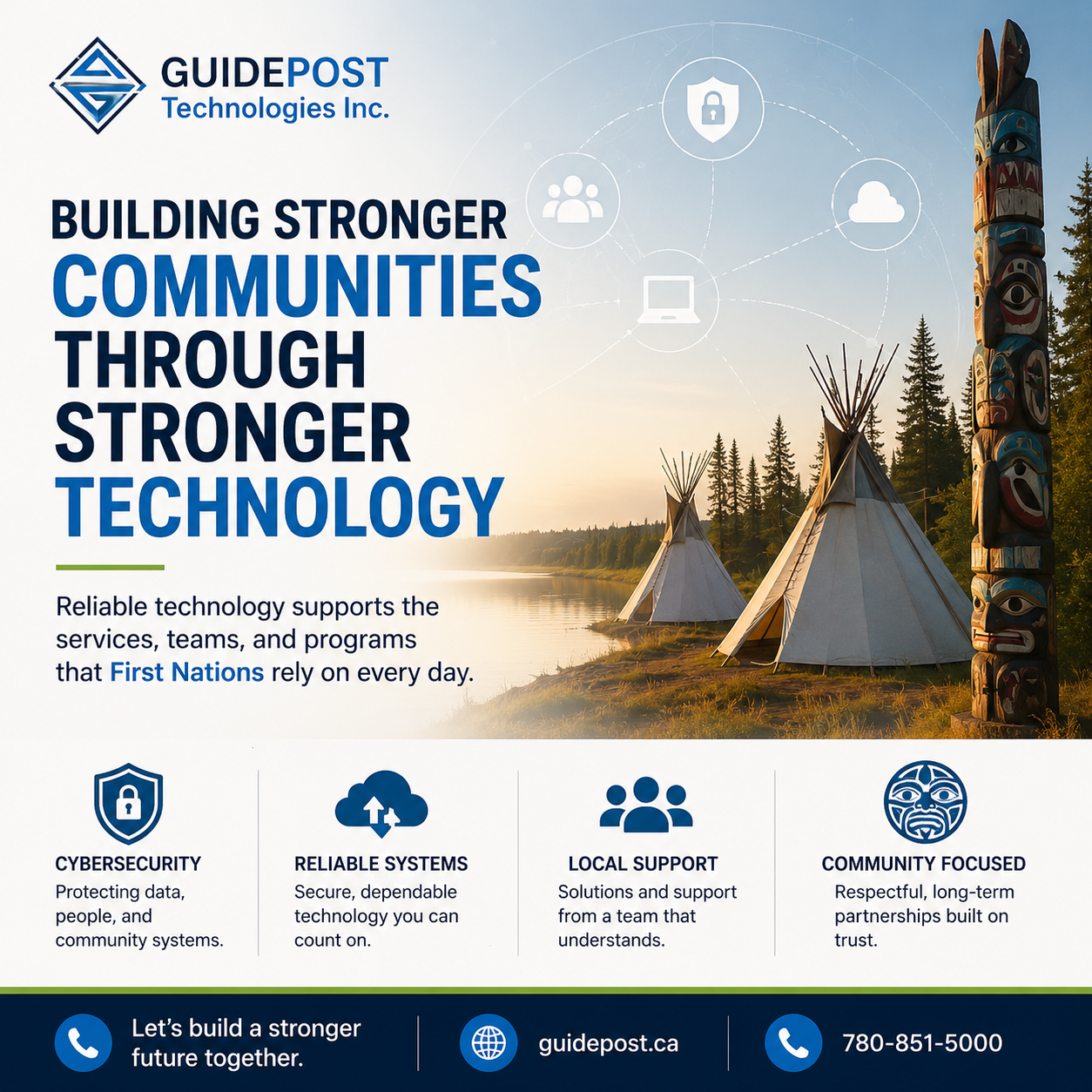
First Nations organizations across Alberta are managing more technology than ever before — and doing it with fewer IT resources than almost any other sector.
Band offices running department-specific domains. Health centres handling patient records under the Health Information Act. Education departments managing student data. Housing, social services, fire halls, and daycares all operating on the same network infrastructure, often in remote communities where the nearest IT provider is hours away.
IT support for First Nations organizations in Alberta is not the same as IT support for a downtown Edmonton law firm. The needs are different, the challenges are different, the compliance obligations are different, and the geography is different. This post addresses what First Nations organizations in Alberta actually need from an IT partner in 2026 — and what questions to ask before engaging one.
The Unique IT Challenges Facing Alberta First Nations Organizations
Geography and Remote Access
Many First Nations communities in Alberta are located hours from major urban centres. Frog Lake, Kehewin, Cold Lake First Nations, Saddle Lake, Whitefish Lake — these communities need reliable IT support but can’t always wait for a technician to drive out for every issue.
The right IT model for a remote First Nations organization combines strong remote support capabilities for day-to-day issues with scheduled on-site visits for infrastructure work, hardware deployment, and assessments. Remote-only IT support fails when physical infrastructure needs attention. On-site-only support is too slow and too expensive for routine helpdesk needs.
GuidePost Technologies serves First Nations communities across northeastern Alberta — including Frog Lake Cree Nation, Alexander First Nation, and others — combining remote helpdesk support with regular scheduled on-site visits. We’ve driven 258km one way to Frog Lake for a scheduled assessment. That’s part of the job.
Multiple Departments, Multiple Domains, Multiple Needs
A First Nations government is not one organization — it’s many. Band administration, health, education, housing, social services, public works, economic development, fire services, and daycares may all operate semi-independently, each with their own staff, data, and sometimes their own email domains.
Managing IT across these departments requires understanding how they relate to each other, what data they share, and where boundaries need to exist. A health department handling patient information under the Health Information Act has different requirements than a housing department managing maintenance requests.
Email domain management alone — ensuring each department has the right addresses, that mail routes correctly, and that former employees are offboarded properly — is an ongoing IT function that many First Nations organizations handle inconsistently because no one owns it.
Compliance with Alberta and Federal Privacy Law
First Nations organizations in Alberta handle significant volumes of personal information — community member records, health data, financial information, children’s data through education and daycare services, and social services files.
This creates compliance obligations under:
Alberta’s Personal Information Protection Act (PIPA) — governs how private sector organizations handle personal information. Many First Nations organizations operating commercial enterprises fall under PIPA.
Freedom of Information and Protection of Privacy Act (FOIP) — applies to public bodies, which may include band councils and their associated entities depending on their structure and funding arrangements.
Alberta’s Health Information Act (HIA) — applies to custodians of health information, including First Nations health centres and programs.
Federal legislation — depending on the organization’s structure and activities, federal privacy legislation and sector-specific regulations may also apply.
An IT provider working with First Nations organizations needs to understand these frameworks — not in a general sense, but specifically enough to configure systems, set data retention policies, and advise on breach notification obligations correctly.
Cybersecurity Threats Targeting Indigenous Organizations
First Nations organizations are increasingly targeted by cybercriminals and, in some cases, by sophisticated threat actors. The reasons are similar to why healthcare and legal firms are targeted — valuable data, funding flows, and historically under-resourced security postures.
Common threats include:
Phishing attacks — targeting band staff through fake government communications, funding notices, or supplier invoices. As we covered in our phishing attacks guide, these attacks have become significantly more sophisticated with AI assistance.
Ransomware — First Nations organizations managing essential services including health and housing are high-value ransomware targets because operational pressure to restore service quickly increases the likelihood of payment. Our ransomware protection guide covers the fundamentals every organization needs.
Business email compromise — fraudulent emails impersonating leadership or funding bodies to redirect payments. Organizations handling INAC/ISC transfers, treaty payments, or capital project funds are specifically targeted.
Unauthorized access through weak credentials — many First Nations organizations have staff who share passwords, use simple passwords, or have never had MFA enabled on their accounts. As we covered in our MFA guide, this is one of the most straightforward risks to address.
Infrastructure in Aging or Expanding Facilities
Many First Nations communities are growing — new buildings, new departments, expanding services. Network infrastructure that was adequate five years ago may not support current needs, and newer facilities need to be properly cabled, networked, and connected to existing systems.
Fire halls, health centres, schools, and administrative buildings all have different network requirements. A fire hall needs reliable communications that don’t depend on a single point of failure. A health centre needs network segmentation to protect patient data. A school needs appropriate content filtering for students.
Getting network infrastructure right in these environments requires on-site assessment and design — not a generic template.
What First Nations Organizations Should Expect from an IT Partner
On-Site Presence, Not Just Remote Tickets
A ticket system is not IT support for a community where the band administrator needs someone who understands the environment, the people, and the history of the infrastructure. The best IT relationships with First Nations organizations are built on regular visits, consistent contacts, and a provider who takes the time to understand what the community actually needs.
Cultural Awareness and Respect
Working with First Nations organizations requires genuine respect for the community, its governance structure, its priorities, and its timeline. IT projects in First Nations communities often involve multiple stakeholders — Chief and Council, department managers, staff — and decisions are made through processes that need to be understood and respected, not rushed.
An IT provider who shows up with a predetermined solution and tries to implement it quickly without consultation will not serve a First Nations organization well. Listening first is not optional.
Clear, Jargon-Free Communication
Technology decisions in First Nations organizations are often made by leaders whose expertise is in governance, community services, or economic development — not IT. An IT partner needs to communicate clearly, explain risks and recommendations in plain language, and never make community leaders feel talked down to or pressured.
Transparent Pricing and Scope
First Nations organizations operate under funding arrangements that require accountability. IT costs need to be clear, predictable, and justifiable to funders and to Chief and Council. Variable or unpredictable billing creates real problems. Managed IT services with flat monthly pricing are generally better suited to First Nations organizations than break-fix arrangements for exactly this reason.
Common IT Questions from First Nations Organizations in Alberta
We have multiple departments on different email domains — how do we manage this properly? This is a Microsoft 365 administration challenge that requires proper domain configuration, shared mailbox management, and clear offboarding procedures for each department. GuidePost has experience managing multi-domain Microsoft 365 environments for First Nations organizations — including department-specific domains like pfnadmin.ca, pfneducation.ca, and similar setups.
Our network can’t support the new building we just opened — what do we do? New buildings need structured cabling, access points, and connection back to the main network. A proper network assessment of the existing infrastructure followed by a design for the new building is the right starting point. Trying to extend an existing network without assessment often creates instability across the whole environment.
We’ve been targeted by a phishing attack — what should we do now? Immediately contact your IT provider. Don’t click any suspicious links, change passwords for any accounts that may have been targeted, and preserve any suspicious emails for analysis. If any accounts were compromised, your IT provider needs to assess the scope before anything is cleaned up — acting too quickly can destroy forensic evidence needed to understand what happened.
How do we protect community member data stored in our systems? Start with access controls — only staff who need specific data should have access to it. Enable MFA on all accounts. Ensure data is backed up and tested regularly as covered in our data backup guide. Work with an IT provider who understands the specific privacy legislation applicable to your organization’s data.
We need VoIP phones — is Teams Phone a good option for a First Nations band office? For most band offices already on Microsoft 365, Teams Phone is an excellent option. It eliminates desk phone hardware, works on any device, and integrates directly with your existing Microsoft 365 environment. Internet connectivity quality at the community is the primary consideration — Teams Phone requires stable, sufficient bandwidth.
Our internet connection is unreliable — what can we do? Unreliable internet in remote First Nations communities is a real constraint. Options include redundant connections from different ISPs where available, LTE backup connections for critical systems, and local caching solutions that reduce dependency on internet connectivity for common tasks. The right solution depends on what connectivity options are available in your specific community.
How do we handle IT when staff turnover is high? Staff turnover is a reality in many First Nations organizations. IT systems need to be set up so that offboarding is quick and clean — accounts disabled, access removed, data secured — and so that new staff can be onboarded without creating a security gap. Managed IT services that include onboarding and offboarding as part of the standard service are the most effective solution.
What’s the difference between IT services and managed IT services for a First Nations organization? IT services in the traditional sense means calling someone when something breaks. Managed IT services means having a provider continuously monitoring your systems, maintaining them proactively, and handling security as an ongoing function — not a reactive one. For First Nations organizations handling sensitive community data and essential services, managed IT is significantly more appropriate than break-fix.
Why GuidePost Technologies Works with First Nations Organizations
GuidePost Technologies has been serving First Nations and Indigenous organizations across Alberta since our founding. Our clients include Métis Nation of Alberta, Alexander First Nation, Frog Lake Cree Nation, and others across the province.
We understand that working with First Nations communities means showing up — literally. We make on-site visits to communities hours from Sherwood Park because that’s what the work requires. We communicate in plain language. We build relationships with the people we work with. And we set up IT systems that are properly documented so that the community is never dependent on us for institutional knowledge.
If your First Nations organization in Alberta is looking for an IT partner who understands your environment and takes the relationship seriously — we’d like to talk.
Explore our Managed IT Services →
Call us at 780-851-5000 or email info@guidepost.ca to start a conversation.
GuidePost Technologies — Managed IT Services, Cybersecurity, Cloud Computing, and Network Support for First Nations Organizations and Businesses across Alberta.