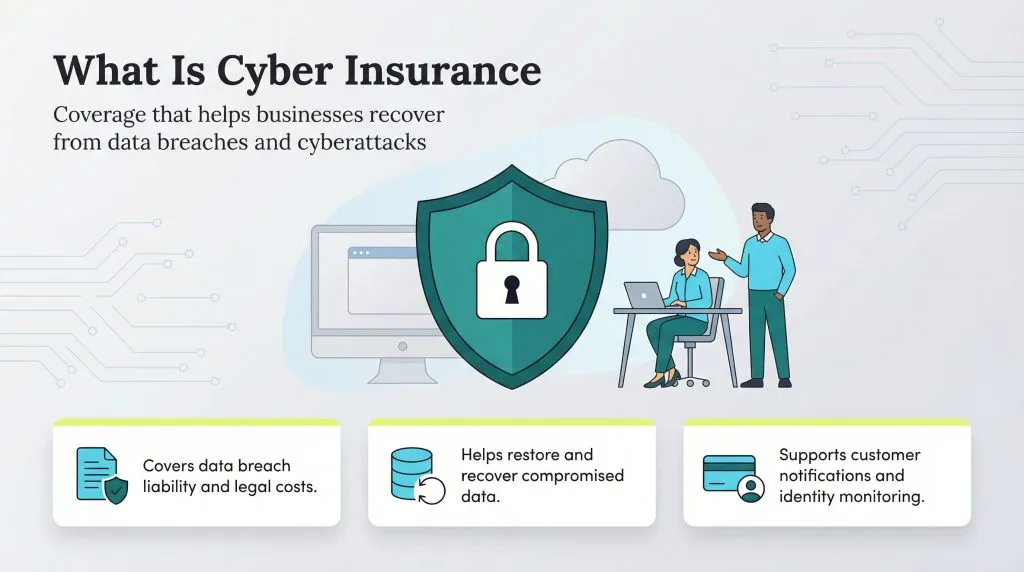
Cyber insurance Alberta businesses carry has changed dramatically — and most Edmonton SMBs either don’t have coverage or don’t understand what their policy actually covers. In 2026, that gap is becoming increasingly dangerous.
A single ransomware attack, data breach, or business email compromise incident can cost a Canadian SMB over $3.4 million when you factor in recovery costs, legal fees, regulatory fines, and lost business. Furthermore, most standard commercial insurance policies explicitly exclude cyber incidents. Without a standalone cyber insurance policy, your Edmonton business absorbs every dollar of that cost directly.
This post explains exactly what cyber insurance is, what it covers, what insurers now require before they’ll cover you, and how to make sure your Alberta business is properly protected.
What Is Cyber Insurance and Why Do Alberta Businesses Need It?
Cyber insurance is a policy that covers the financial losses your business suffers as a result of a cyberattack, data breach, or related incident. As a result, it works alongside your cybersecurity controls — not instead of them.
As we covered in our guides on ransomware protection, phishing attacks, and data backup and recovery, the financial consequences of a cyberattack extend far beyond fixing the technical damage. Cyber insurance Alberta businesses carry specifically addresses those broader costs. Consequently, it has become an essential part of any complete risk management strategy for Edmonton and Alberta SMBs.
What Cyber Insurance Covers for Edmonton Businesses
Policies vary, but most comprehensive cyber insurance policies for Alberta SMBs include two main categories:
First-party coverage — costs to your own business:
- Ransomware payments and negotiation costs
- Data recovery and system restoration
- Business interruption losses while systems are down
- Forensic investigation costs
- Breach notification costs for affected clients and employees
- Credit monitoring services for affected individuals
- Crisis communications and public relations costs
Third-party coverage — claims made against your business:
- Legal defence costs if clients sue following a breach
- Regulatory fines and penalties under Alberta’s PIPA or federal PIPEDA
- Settlements arising from data breach lawsuits
What most policies do NOT cover:
- State-sponsored attacks or acts of war
- Pre-existing vulnerabilities known before the policy was issued
- Social engineering fraud where an employee willingly transfers funds (this requires separate coverage)
- Bodily injury or property damage
Therefore, it’s essential to read your policy carefully. Coverage gaps are common, and discovering them before a claim — not during one — is critical.
Why Cyber Insurance Alberta Businesses Can Qualify For Has Tightened
Three years ago, getting cyber insurance was relatively straightforward. Today, however, insurers have significantly tightened requirements because claim volumes have skyrocketed. Moreover, many Alberta SMBs are now being denied coverage or facing premiums they can’t afford — not because insurers don’t want their business, but because those businesses don’t meet minimum security requirements.
The most common reasons Edmonton businesses are denied cyber insurance:
No multi-factor authentication — This is now a hard requirement from virtually every insurer. Specifically, if MFA is not enabled on Microsoft 365 and other critical systems, many insurers won’t issue a policy at all. We covered how to set this up in our MFA guide.
No endpoint protection — Basic antivirus is no longer sufficient. Instead, insurers want to see endpoint detection and response (EDR) solutions running on all devices.
No tested backup — Having a backup alone is not enough. In addition, insurers increasingly require evidence that backups are tested regularly, stored offsite, and isolated from the main network. Our data backup and recovery guide covers what a proper backup strategy looks like.
Outdated systems — Running unsupported operating systems or unpatched software is a red flag that results in denied coverage or exclusions.
No security awareness training — Insurers want documented evidence that employees receive regular phishing and cybersecurity training.
The pattern is clear: insurers effectively require businesses to implement basic cybersecurity hygiene as a condition of coverage. Businesses that have done this work get better coverage at lower premiums. Those that haven’t are increasingly uninsurable.
How Much Does Cyber Insurance Cost for an Alberta SMB?
Premiums vary based on industry, revenue, employee count, data sensitivity, and security controls in place. As a rough guide for Edmonton and Alberta SMBs:
- Small businesses under 20 employees with basic security controls: $1,500 to $4,000 per year
- Medium businesses with 20–50 employees: $4,000 to $12,000 per year
- High-risk industries (healthcare, legal, financial services): typically 30–50% higher than the above ranges
Importantly, businesses with strong security controls — MFA enabled, EDR deployed, tested backups, documented security policies — routinely qualify for lower premiums and broader coverage. Therefore, investing in cybersecurity isn’t just about reducing risk. It directly reduces what you pay for insurance.
Cyber Insurance Claims: What Edmonton Businesses Need to Know
Understanding how claims work before you need to file one is essential. Most policies require the following:
Immediate notification — Most cyber insurance policies require you to notify your insurer within 24 to 72 hours of discovering an incident. Consequently, failing to notify promptly can jeopardize your entire claim.
Insurer-approved vendors — Many insurers maintain panels of approved forensic investigators, legal counsel, and PR firms. Using non-approved vendors without insurer consent can reduce or void your coverage.
Full documentation — You’ll need to document the incident, response actions taken, and all costs incurred. This is one reason a managed IT provider adds significant value — they generate the documentation you need automatically.
Full cooperation — Policies require complete cooperation with the insurer’s investigation. Furthermore, making independent decisions about ransom payments without insurer involvement can void coverage entirely.
Cyber Insurance and Regulatory Compliance in Alberta
Alberta businesses handling personal information have obligations under PIPA and potentially PIPEDA that intersect directly with cyber insurance. Specifically, a breach exposing personal information may trigger:
- Mandatory notification to affected individuals
- Mandatory reporting to the Office of the Information and Privacy Commissioner of Alberta (you can learn more at oipc.ab.ca)
- Regulatory investigation and potential penalties
Cyber insurance policies that include regulatory coverage help offset the legal fees, notification costs, and in some cases regulatory fines that follow a breach. However, not all policies include this — so confirm with your broker before signing.
What to Look For When Buying Cyber Insurance in Alberta
When evaluating policies, Edmonton businesses should ask their broker:
- Does the policy cover ransomware payments and negotiation costs?
- Is business interruption included, and what’s the waiting period?
- Does the policy cover social engineering and funds transfer fraud?
- What are the notification requirements and timeframes?
- Are there sublimits on specific coverage types that effectively reduce the payout?
- Does the policy include incident response services, or are those out of pocket?
- What security controls must be maintained to keep coverage active?
Cyber Insurance Is Not a Substitute for Cybersecurity
This is the most important point in this post. Cyber insurance pays for the damage after something goes wrong. It does not prevent the attack. Moreover, it does not recover your reputation with clients whose data was exposed. It also does not give back the weeks of productivity lost while systems are restored.
Additionally, cyber insurance does not cover everything — there are always exclusions, sublimits, and gaps. The businesses that suffer the least when an incident occurs are the ones with both strong cybersecurity controls and cyber insurance. One without the other is incomplete protection.
Frequently Asked Questions
Does my general business insurance cover cyberattacks? Almost certainly not. Standard commercial general liability policies explicitly exclude cyber incidents. Therefore, you need a standalone cyber insurance policy for proper coverage.
Is cyber insurance mandatory in Alberta? It is not legally mandatory. However, it is increasingly required by clients — especially in healthcare, legal, and government contracting. Given the financial consequences of a breach, it is effectively essential for any business handling sensitive data.
What happens if I have a breach and no cyber insurance? You bear all costs directly — forensic investigation, system restoration, legal fees, notification costs, regulatory fines, and lawsuits. For most SMBs, these costs are catastrophic. The average total cost of a data breach for a Canadian SMB exceeds $3.4 million.
Can I get cyber insurance if I’ve had a breach before? Yes, but previous incidents will affect your premium and coverage terms. Full disclosure is required — failing to disclose a prior incident can void a future claim.
How do I prove to an insurer that I have proper security controls? Most insurers require a security questionnaire and some conduct technical assessments. Having a managed IT provider who documents your security controls, backup procedures, and MFA configuration makes this process significantly smoother.
What is the difference between IT services and managed services for insurance purposes? Managed IT services provide ongoing, documented security oversight that insurers can verify — including patch management, monitoring logs, backup records, and MFA enforcement. Break-fix IT support, by contrast, generates little documentation and provides no continuous security monitoring. Consequently, businesses with managed IT typically qualify for better insurance terms.
GuidePost Can Help You Get and Stay Insurable
GuidePost Technologies helps Edmonton and Sherwood Park businesses implement the cybersecurity controls cyber insurers require — including MFA, endpoint protection, tested backups, security training, and documented security policies. As a result, our clients are better positioned to qualify for comprehensive cyber insurance at competitive premiums.
Explore our Cybersecurity Services →
Call us at 780-851-5000 to book a free cybersecurity assessment. We’ll identify what your business needs to meet insurer requirements and protect itself from the threats that make cyber insurance Alberta businesses need so essential in 2026.
GuidePost Technologies — Managed IT Services, Cybersecurity, Cloud Computing, and Network Support for Edmonton and Alberta Businesses.
6 Reply on “Cyber Insurance Alberta: What Every Edmonton Business Needs to Know in 2026”